
Nearly a third of an average Indian citizen's consumption budget is spent on food.

Oil and LNG prices are likely to shoot up if Iran is to block Strait of Hormuz, through which countries like India import crude oil from Saudi Arabia, Iraq and UAE, leading to a spike in inflation, analysts said on the Iran-Israel conflict. The Iran and Israel conflict has escalated over the last few days. Iran first launched drone and rocket attacks on Israel, which retaliated by firing a missile. Crude oil prices have hovered around USD 90 per barrel since the conflict.

While demand for sub Rs 50-lakh affordable housing prevails, market players cite increased land rates, escalated construction costs and low margins as key prohibiting factors.

Foreign investors have made a strong comeback to Indian equities with a net investment of Rs 22,766 crore in the first two weeks of December driven by expectations of rate cut by the US Federal Reserve. This revival follows significant outflows in the preceding months, with Foreign Portfolio Investors (FPIs) pulling out a net Rs 21,612 crore in November and a massive Rs 94,017 crore in October -- the worst monthly outflow on record.

Britannia Industries will take higher grammage cuts instead of increasing prices in a bid to tackle rising inflation, the firm said. The biscuit major took a 10 per cent price hike in financial year 2021-22 (FY22) and resorted to reducing pack sizes as an indirect way of increasing prices. In the previous financial year, the ratio of grammage reduction was 65 per cent, which will be higher in FY23.

Rates would stay high for longer as CPI inflation now stands at nearly 10 per cent.

While headline and core WPI are stuck in a disinflationary phase, the retail measure is inching north.
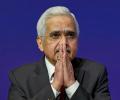
The highlights of RBI's bi-monthly monetary policy announced by Governor Shaktikanta Das:
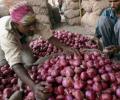
The government on Saturday imposed a 40 per cent duty on the export of onions to increase domestic availability amid signs of increasing prices. The export duty, which is the first time ever on onion, has been imposed as the retail sale price of the kitchen staple, according to government data, touched Rs 37/kg on Saturday in Delhi. The finance ministry through a Customs notification imposed a 40 per cent export duty on onions till December 31, 2023.

The wholesale price-based inflation rose to 2.03 per cent in January, 2021, even as food prices cooled. The WPI inflation was 1.22 per cent in December, 2020 and 3.52 per cent in January last year. While food articles saw softening in inflation in January, manufactured items witnessed hardening of prices, as per data released by the Commerce and Industry ministry.

DBS called Rajan's decision not to seek an extension as a 'negative surprise'.
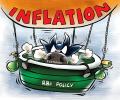
The RBI on Friday retained inflation forecast for FY23 at 6.7 per cent amid uncertain price trajectory on "geopolitical shocks" and on hope that inflationary pressures would ease with pick-up in kharif sowing and supply chain improvements. In its previous monetary policy review in June, it had projected retail inflation for 2022-23 at 6.7 per cent, higher from 5.7 per cent forecast in April. The six-member Monetary Policy Committee (MPC) unanimously decided to raise the benchmark repo rate by a steep 50 basis points to 5.40 per cent with immediate effect to tame inflation while supporting growth.
Use a mix of instruments that will beat both the wholesale and consumer price indices

The government on Monday ruled out making public the RBI report detailing the reasons why the central bank could not keep inflation within the targeted 6 per cent upper limit for the three consecutive quarters. "Yes sir, RBI has furnished a report to the central government, as mandated under Section 45ZN of the RBI Act, 1934 and Regulation 7 of RBI Monetary Policy Committee and Monetary Policy process Regulations, 2016," minister of state for finance Pankaj Chaudhary said in a written reply. The said provisions of the RBI Act, 1934, and regulations therein does not provide for making the report public, he said.

Indian equity markets should be able to withstand inflation up to 8 per cent, said analysts at Credit Suisse Wealth Management in a recent note. Should the rate of inflation move higher than this, the valuation of Indian equities could deteriorate further, they cautioned. The fall from the peak levels has seen Nifty's 12-month forward price-to-earnings (P/E) ratio of 17.6 dip toward its 10-year and 5-year (pre-COVID) average of 16.9, which suggests that valuation froth of Indian equities has settled, said the Credit Suisse analysts.

"These latest so-called 'Liberation Day' tariffs are reckless and self-destructive, inflicting financial pain on Illinois at a time when people are already struggling to keep their small businesses afloat and put food on the table."

The Indian economy is recovering from the slowdown in momentum witnessed in the September quarter, driven by strong festival activity and a sustained upswing in rural demand, according to a Reserve Bank of India (RBI) bulletin released on Tuesday. An article on the 'State of the Economy' in the December bulletin noted that the global economy continues to exhibit resilience with steady growth and moderating inflation.
With concern on food inflation ebbing with the monsoon progressing well, the Reserve Bank of India (RBI) is warming up to the idea of a change in stance to "neutral" from "withdrawal of accommodation", according to economists. In his speech on Thursday during the annual event of the Federation of Indian Chambers of Commerce and Industry-Indian Banks' Association, RBI Governor Shaktikanta Das said: "The balance between inflation and growth is well-poised."

Indian households database Consumer Pyramids answers why two years of high inflation did not matter to the consumers of the country.

'Always ensure that lease terms are clearly written in the agreement, including rent escalation clauses and notice periods.'

International oil prices continue to be extremely volatile, falling on one day and rising thereafter, a top oil ministry official said explaining the reason behind no reduction in petrol and diesel prices despite softening in input cost, but could not say if the rates will be cut before Maharashtra elections. Global oil benchmark Brent crude futures fell below $70 per barrel last week -- the first time since December 2021 -- but gained thereafter. Brent was trading at $74.58 per barrel on Thursday while West Texas Intermediate advanced to trade at $71.71.
According to data released on Thursday, Wholesale Price Index-based inflation rose to seven per cent in October from 6.46 per cent in September.

Fall in both WPI and CPI inflation to pressure RBI, say analysts

'If you compare the data from 2017 and 2023 of the US imports from the world and China, you will see that the US was a complete loser in the trade war, and China was a complete gainer.'

India will be the world's third-largest economy by 2028 as it becomes the world's most sought-after consumer market and gains share in global output, driven by macro stability influenced policy and better infrastructure, Morgan Stanley said. From a $3.5 trillion economy in 2023, the Indian economy is projected to expand to $4.7 trillion in 2026, which will make it the fourth largest in the world behind the US, China and Germany.

The fast-moving consumer goods (FMCG) sector is likely to report muted results in the fourth quarter of 2024-25 (Q4FY25) due to weakness in urban consumption. The weakness may persist through the first half of 2025-26 (H1FY26).

TDP supremo N Chandrababu Naidu consistently emphasises, among others, the issue during his campaign, alleging that the state has been supplying poor quality liquor while profiting immensely from 'inflated' prices, running to thousands of crores of rupees.

Inflation in fruits was 8.93 per cent.
In a data-packed week, the domestic macroeconomic figures -- industrial production and inflation numbers -- along with global trends would dictate trends in the equity market this week, analysts said. According to experts, markets may face volatile trends due to high valuations. Equity benchmark indices Sensex and Nifty hit their fresh record peaks on Thursday. Besides, trading activity of foreign investors, movement of global oil benchmark Brent crude and rupee-dollar trend would also influence trading in equities.

The rate of price rise for consumer foods eased to 4.7 per cent in January, from 4.96 per cent in December.

The FMCG industry hopes for a revival in consumption growth in 2025 with some 'green shoots' already visible, after having a challenging year amid escalating input costs and a double-digit rise in food inflation, which ultimately slowed down the pace of the urban market growth in the second half of 2024. Soaring prices of commodities such as palm oil, coffee, cocoa and wheat forced FMCG players to go for a hike of 3 to 5 per cent or resort to shrinkflation by reducing pack sizes and grammage to retain attractive price points, fearing a volume loss.

The Reserve Bank of India on Friday decided to keep the policy rate unchanged at 6.5 per cent for the fifth time in a row as it maintains a tight vigil on inflation. The rate increase cycle was paused in April after six consecutive rate hikes, aggregating to 250 basis points since May 2022. Announcing the bi-monthly monetary policy, RBI Governor Shaktikanta Das said the Monetary Policy Committee (MPC) unanimously decided to keep the repo rate unchanged at 6.5 per cent.

'The RBI's MPC will maintain the current policy rates (6.50%) at the policy meeting, given ongoing inflationary pressures.'

Data earlier on Thursday showed the annual consumer price inflation rose to a higher-than-expected 11.24 per cent in November from 10.17 per cent in October.
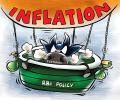
The RBI's Monetary Policy Committee brainstormed the impact of any future shocks on the inflation trajectory and stressed monitoring the cumulative effect of monetary policy actions over the past one year, which is still unfolding, revealed minutes of the rate-setting panel released on Thursday. The minutes of the meeting of the Monetary Policy Committee (MPC), headed by Reserve Bank Governor Shaktikanta Das, also indicated it would be premature to declare an end to the monetary tightening cycle, which started in May 2022 to check high inflation following the outbreak of the Russia-Ukraine war. The central bank, which effected six back-to-back hikes in the key short-term lending rate (repo) since May 2022 to check high inflation, decided to take a pause early this month.

'2025 is the year to build a portfolio for the future. Focus this year should be on valuations and visible growth.'
The commodity price shock absorber is no longer working as it did in the past

The Budget should undertake further reductions in import tariffs and seriously consider an announcement of India's intention to join one or both of the two Asian mega-regional free trade agreements, suggests Shankar Acharya, former chief economic adviser to the Government of India.

The wholesale price-based inflation shot up to an all-time high of 10.49 per cent in April, on rising prices of crude oil and manufactured items. Also, a low base of April last year contributed to the spike in inflation in April 2021. The WPI inflation was 7.39 per cent in March 2021, and (-) 1.57 per cent in April 2020. This is the fourth straight month of uptick seen in the wholesale price index (WPI)-based inflation.

'The central bank has highlighted that the slowdown in growth has been limited to a few sectors and overall growth is expected to pick up in the second half of the year.'
 © 2026 Rediff.com - Advertise with us - Disclaimer - Privacy Policy - Sitemap - Feedback - About us - Terms of use - Grievances